We study the fundamental biology of spider silk to understand how spiders manage the phenomenal task of producing large quantities of protein, keeping these stable in solution for extended periods, and then rapidly converting the proteins into the world’s toughest fiber. Our research has led to a deeper understanding of this process, which formed the basis for developing the first biomimetic process to produce artificial spider silk.
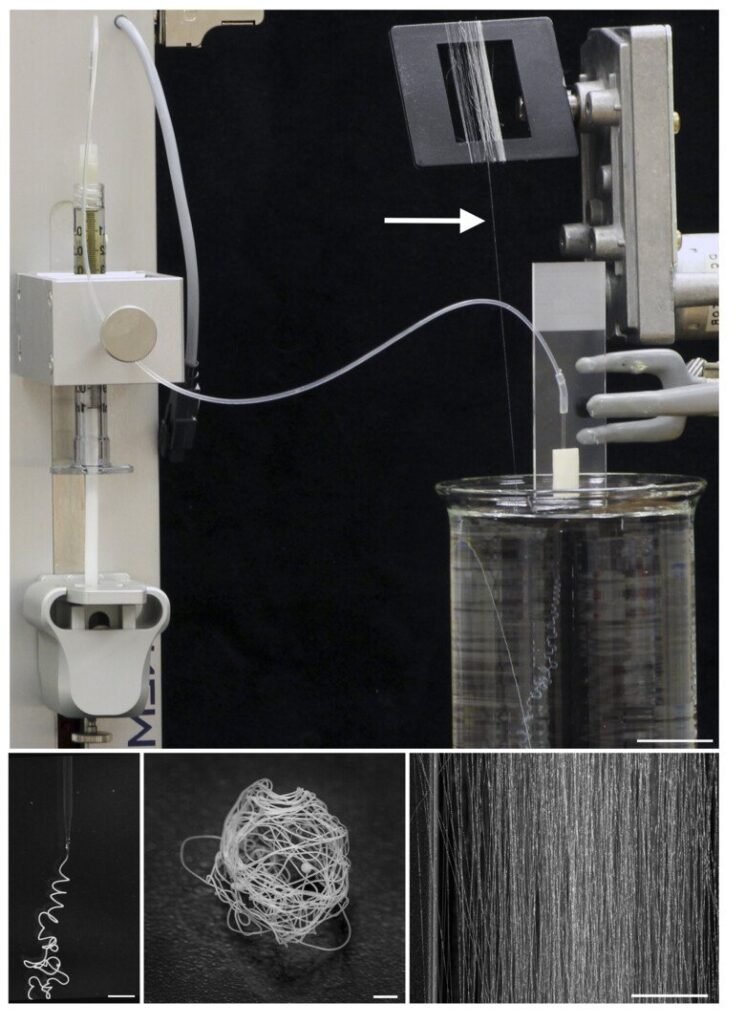
The silk proteins are produced and purified from heterologous hosts, primarily E.coli, in scalable fermentation processes. We have succeeded in designing proteins and processes that results in unprecedented production levels of water-soluble proteins. The water solubility of our proteins is unique and means that the proteins have adopted a correct three-dimensional fold (meaning that they are functional). Consequently, they respond correctly by polymerizing when they are exposed to a slightly lower pH, which is the method the spider uses to spin its fiber. This means that we have developed a biomimetic spinning process based solely on water-based solutions and ambient temperatures, that give us fibers that are as tough as native spider silk.
Our fibers are of interest for use in many fields, such as high-performance textiles, the manufacturing of protective gear and sports equipment, and they also appear to be well tolerated when implanted in living tissue. Therefore, we also focus on regenerative medicine (tissue reconstruction). The long-term goal is to be able to replace or restore damaged organs and structures.
Recently, we also discovered that our spider silk proteins form gels when exposed to a temperature of 37°C. This means the material could potentially be injected as a solution and form a gel in place. Furthermore, through protein engineering, we can modify the spider silk proteins to have different functions (for example, attaching colored proteins or cell-binding proteins), thereby obtaining a material that is bioactive.
Basic studies of the structure and function of the silk glands
Using transcriptomics, proteomics, histology, Raman spectroscopy, confocal microscopy, electron microscopy (including cryo-FIB-EM) and microelectrodes
Investigation of the function of different proteins
Recombinant production and purification of silk proteins. Biophysical characterization using e.g. chromatographic methods, CD spectroscopy, and mass spectrometry.
Up-scaled production
The fermentation and purification processes are being optimized and transferred to large-scale manufacturing.
Biomimetic manufacturing of materials
The recombinant proteins are spun into fibers using all-aqueouse process, used to make hydrogels by simply increasing the sample temperature to 37°C, or used to make films by casting.
Functionalized materials
The unique combination of recombinant protein production and mild processing conditions enable us to modify the proteins to contain different bioactive moieties that retain their structure and function also in the polymerized state of the material (in the gels, fibers, films). This means that we efficiently can produce materials with bioactive functions like enzymatic activity, cell instructive abilities, or color.
Biomaterial characterization
We use rhemometry and FTIR spectroscopy to evaluate the properties of solutions and hydrogels. Films and fibers are evaluated primarily by tensile testing under different conditions.
Applications of the material
The fibers are currently being developed for making yarns and textiles. The fibers, silms, and hydrogels are evaluated for their ability to support different cell types, intended for applications in regenerative medicine.
Machine learning to improve material properties
Machine learning is used to inform on optimal amino acid sequences for gaining predetermined fiber properties. Another line of research is to create de novo proteins with similar functions as the silk proteins found in nature.